
1st Online Computer Vision and Artificial Intelligence Workshop (OnCV&AI)
July 26th – July 30th, 2021, Tainan, Taiwan
We sincerely invite anyone in the world interested in spatial AI to participate. The workshop is held online and is free for everyone.

About the Workshop
This workshop is part of a series created for Ph.D. students, and other skilled engineers, to explore online computer vision and artificial intelligence techniques on the OAK-D camera. It consist of a few seminar speeches and a hackathon, distributed over a week.
During the hackathon everything is done online and implemented in real-time by our hackers on our OAK-D cameras as suggested by the audience. Everything is streamed on YouTube and Twitch.


About OAK-D
Luxonis and OpenCV AI Kit with Depth (OAK-D) has won the Best Camera and Sensor product of the year award by the Edge AI and Vision Alliance.
Luxonis is the company that has developed the OpenCV AI Kit. We received these cameras as finalists in the OpenCV AI competition 2021.
About the Team
This workshop is arranged by the Nordling Lab located at the Dept. of Mechanical Engineering, National Cheng Kung University. It is sponsored by the National Cheng Kung University in Taiwan. We are part of the “National Cheng Kung University‘s Parkinson’s Disease Quantifiers” team lead by Ass. Prof. Torbjörn Nordling and Asc. Prof. Chi-Lun Lin selected as a finalist in the OpenCV AI competition 2021 out of more than 1400 teams globally.
The team consists of Dr. Akram Ashyani, Jose Chang, Esteban Roman, Tachyon Kuo, Gavin Vivaldy, Jacob Chen, Yushan Lin, Ric Tu, Prof. Chi-Lun Lin, and Prof. Torbjörn Nordling. We are working on quantification of motor degradation in Parkinson’s disease together with Prof. Chun-Hsiang Tan at Kaohsiung Medical University, and Dr. Chad Tsung-Lin Lee and Dr. Chung-Yao Chien at National Cheng Kung University Hospital. More precisely, on analysing the use of micro motions for assessment of motor degradation based on the Unified Parkinson’s Disease Rating Scale (UPDRS).
Speakers & Hackathon

Bio: Brandon is an Electrical Engineer driven to deliver products that materially impact the world. He’s on a mission to improve the engineering efficiency of embedding performant, spatial AI and CV into products.
Abstract: We’re approaching an inflection point where computer vision can be used in ways that were before completely impractical because of the size, weight, and power of the necessary computational resources. At Luxonis, our North Star of the DepthAI platform is to make all the components (hardware, firmware, software, CV, and AI) that allow an active collision-deterrence system to be built using the platform, to keep people who ride bikes safe from distracted drivers. This talk goes over where we are on that journey, and the problems along the way that are already solvable with the state of DepthAI today.

Prof. Shih-wei Liao,
National Taiwan University
Certificateless aggregate signature for multi-level blockchain
July 27th, 17:00
Bio: Shih-wei Liao, Ph.D., received his Ph.D. and M.S. from Stanford University and his bachelor’s degree from National Taiwan University. He worked at Silicon Valley (Stanford, Google and Intel) for more than 20 years, culminating at receiving Google’s highest award, Founders’ award. His research interests include Blockchain, Big Data, and Fintech. He is one of the original authors of Android compiler, Virtual machine, RenderScript engine. He leads a team that releases the Gcoin Blockchian and CPoW consensus algorithm and launched first courses on Fintech and Blockchain at National Taiwan University.
Abstract: Based on our experience in applying Gcoin 1.0, 2.0 and 3.0 to real-world applications, we design BigCoin (BC) 1.0. The first feature of it is the certificateless aggregate signature (CLAS), because real-world IoT applications need scalable ID scheme. BC-CLAS is an efficient certificateless aggregate signature scheme with constant pairing computations. Certificateless public key cryptography is introduced to solve the resource-intensive and costly certificate management in traditional public key infrastructure and the key escrow problem in identity-based cryptography. Thanking to aggregate signatures, our scheme not only keeps data integrity, but also reduces bandwidth and computational cost, which is attractive for authentication in a resource-constrained IoT blockchain environment.
In addition, our CLAS scheme is provably secure against existential forgery on adaptive chosen message attack in the random oracle model based on the computational Diffie–Hellman assumption. Furthermore, the proposed scheme results in lower computational overhead than the cost in the existing well-known schemes. Our scheme is suitable for practical use..

Prof. Kuo-Shih Tseng,
National Central University
Transfer learning of coverage functions via invariant properties in the Fourier domain
July 28th, 10:00
Bio: Kuo-Shih Tseng is an assistant professor in the Department of Mathematics, National Central University, Taiwan. He received his B.S. degree in Mechanical Engineering from Chung Yuan Christian University, Taiwan, in 2002, and his M.S. degree in Bio-Industrial Mechatronics Engineering from National Taiwan University, Taiwan, in 2004. He received his second M.S. degree and Ph.D. in the Computer Science and Engineering from University of Minnesota in 2013 and 2016, respectively. From 2004 to 2009, he was an associated researcher with the Intelligent Robotics Technology Division, Industrial Technology Research Institute (ITRI), Hsinchu, Taiwan. His current research interests include robotic search, human search behavior analysis, and reinforcement learning.
Abstract: The robotics community has been paying more attention to coverage functions due to their variant applications (e.g., spatial search and mapping, etc.). Due to their submodularity, greedy algorithms can find solutions with theoretical guarantees for maximizing coverage problems even if these problems are NP-hard. However, learning coverage functions is still a challenging problem since the number of function outcomes for N sets is 2^N. Moreover, transfer learning of coverage functions is unexplored. This research focuses on the transfer learning of coverage functions via utilizing the invariant properties in the Fourier domain.
The proposed algorithms based on these properties can construct Fourier support for learning coverage functions. Experiments conducted with these algorithms show that the robot can learn the coverage functions using less samples than the prior learning approaches in different environments. Experiments also show that the lossless compression rate of the proposed algorithms is up to 40 billion.

Hackathon
July 26th – July 30th, 2021
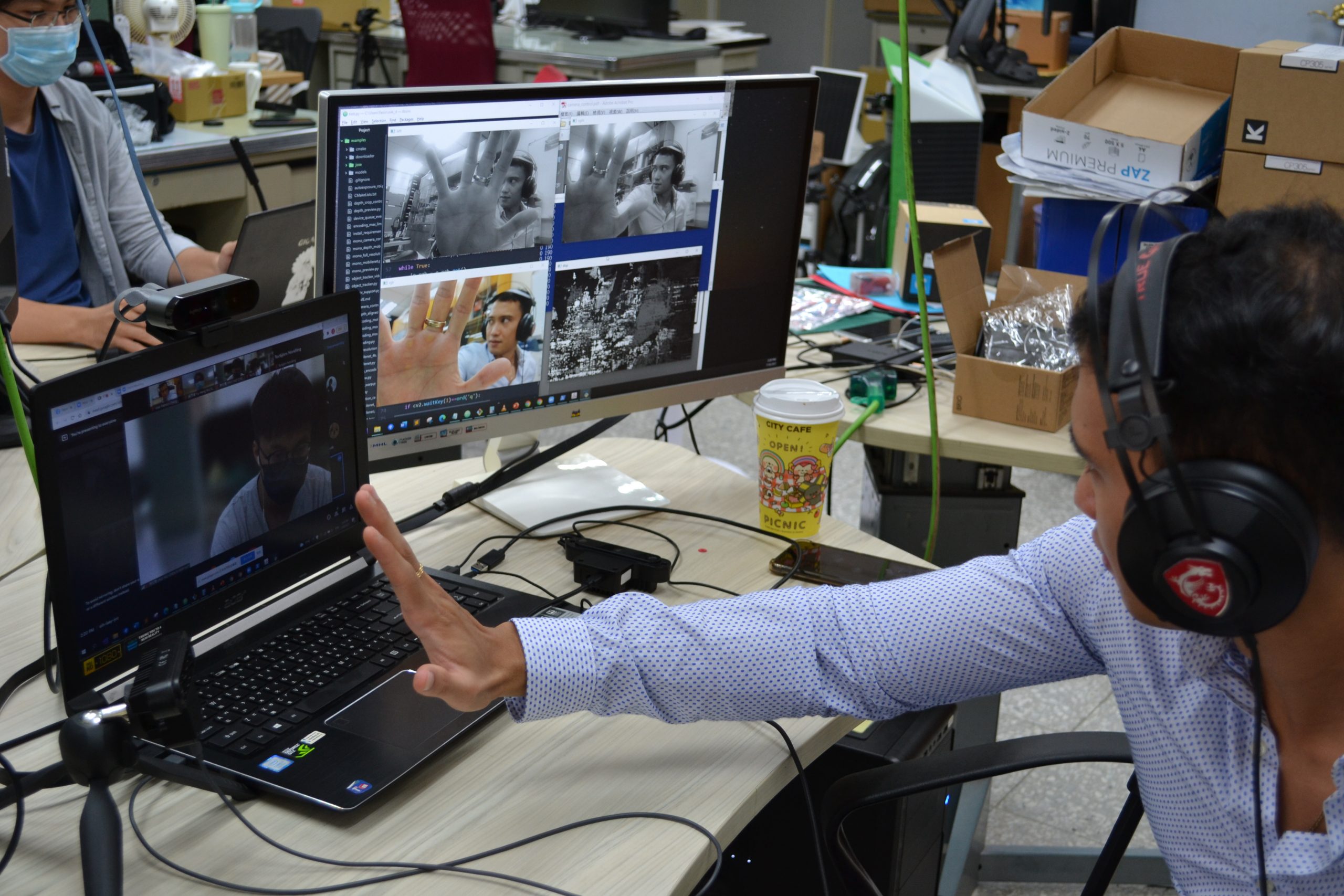
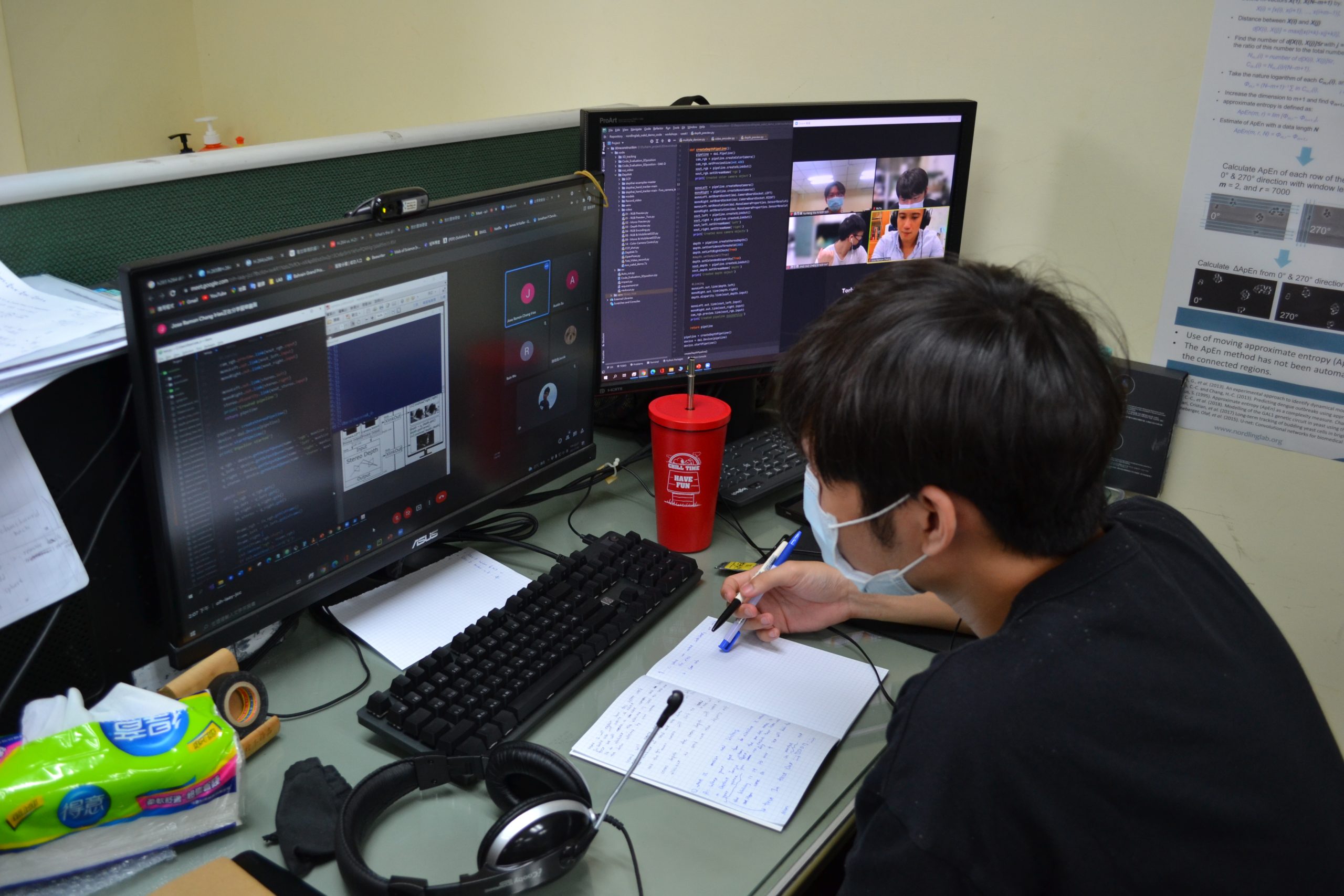
Interactive live exploration of spatial AI applications on the OAK-D camera based on suggestions from the speakers and audience. This is conducted by our hackers: Jose Ramon Chang, Jacob Chen, and Ric Tu, with Rain Wu handling communication with the audience.
Schedule
July 26th – July 30th, 2021
27
July
09:00 – 10:00
Brandon Gilles,
CEO Luxonis
Commute Guardian – DepthAI’s North Star
17:00 – 18:00
Prof. Shih-wei Liao,
National Taiwan University
Certificateles
28
July
10:00 – 11:00
Prof. Kuo-Shih Tseng,
National Central University
Transfer learning of coverage functions via invariant properties in the Fourier domain
30
July
13:00 – 15:00
1st OnCV&AI Hackathon,
National Cheng Kung University
Interactive live exploration of spatial AI applications on the OAK-D camera based on suggestions from the speakers and audience.
Subscribe to our workshop calendar
Upcoming Workshops
Follow the Live Stream
Everything is streamed in English on YouTube and Twitch


Recorded Talks & Hackathon
Brandon Gilles,
CEO Luxonis
Commute Guardian – DepthAI’s North Star
July 27th,
09:00
Q&A
Q1. The work you are doing is impressive, what have you on purpose decided to not implement for OAK-D that you think would work and be useful?:
Brandon: That’s a really good question. We’re not doing anything that has to do with security cameras. My thought behind that is like consumer electronics. You know I’ve known a lot of folks in my circle or not in my circle they’re like consumer electronics. I’m gonna do that like I know about my home in this thing that’s annoying to me in my home. So do you and so does everyone else. To me, the security cameras it’s kind like the first thing that everyone’s like, oh man AI would be useful for security cameras. It’s like yep you and every other smart person has thought of that and there’s this huge oversupply of intelligence and time being thrown at making security cameras, which just means if you throw your life into doing that or your effort in doing it, you’re just likely not going to get many fruits from your labor. You know if everyone’s all doing exactly the same thing all the time, unless you need a bajillion of them, which security cameras you kind of do. You know it just means to be hyper competitive and really difficult and you’re just not adding value and so you know we got a lot of initial pull in like, well you should make security cameras and so that was probably like if you were to rand the things of like the thing we were asked for the most and then I didn’t do it’s that right? There are some other things like, you know multi-camera like real-time stitching that actually our platform would be good for in and I think it could be a great feature but it’s a really high ask and it kind of like a limited audience we’ll probably do it later but the thing that we’re really avoiding that gets asked for a lot is building a security camera out of this.
Q2: For the hard synchronization, what is the limitation speed it can catch?
Brandon: We actually have data on that. Let me see if I can pull it up so I can just tell you actual numbers. It’s sub millisecond for sure. So the worst case is with like rgb cameras synced to grayscale that actually don’t have hard sync and so we do a firmware equivalent of hard sync in there. So this is the worst case offset but this shows the left right as well so actually just share this. So we just updated this with our gen1 api and then we’re bringing and improved version from our gen1 api for the hard sync. So it’s tricky because these differences are in milliseconds so this is 0.7 milliseconds, so 785 microseconds and this is when the thing first boots up so it hasn’t had time to really start the synchronization. So you can see that it kind of oscillates around a little bit after 12 frames or 16 frames movie or under 100 microseconds and after that looks like the worst case is maybe 70 microseconds between rgb to grayscale and right to left is what has the hardware synchronization. This comes down to measurement error as well they actually might be better sync than this but you’re looking at 11, 10, 9, 12 microseconds but it’s that comes down to our capability to measure how offset they are and then this is a view of the sink so the left and right then grayscale of literally just you know pointing at a device or at a timer.
Q3. You have selected a very challenging north star and you are well on the way. Could you provide your best estimate of the final size and battery life of the commute guardian for bikers?
Brandon: That’s a good question. This gives an idea of just kind of like the electronics heatsink. You could just build into an enclosure but to just give an idea. When you put it on a bike this isn’t really like the form factor you’d want it’d probably be, you know because generally on a bike you just want it to like adhere to the seat post so this is about as wide as a seat post. This is closer to the form factor and this has everything that you’d need when you build it into an actual like commute guardian you just make the commute guardian out of aluminum. Similar to like an OAK one, this is completely aluminum, so to give you the size, so imagine this but a little bit taller. What we’re thinking is without any optimization so you’re just running the thing full out all the time so you’re doing all these features all the time when you don’t need to, you’re looking at probably 10 hours of battery life out of a worst case out of like a 10 amp hour battery. You’re probably looking at higher than maybe like 15. 10 hours maybe is a good estimation but the thing that we want to add as well which is coming like q4 this year to the api is some more intelligent, like power thresholding modes. For example in the commute guardian, you could do an image classifier to start that’s running that takes way less power you’re not calculating 3d trajectory or platform motion or anything you’re just doing an image classifier at some frame rate, maybe five frames a second, which just detects if there’s a car behind you and when you do something like that instead you could very reasonably extend the battery life to maybe 20 hours. Because it just sipping power, telling is there just a car in the scene and when there isn’t, obviously doing a lot less it’s just effectively being a bike light with a low rate image sensor and once there’s a car in the scene then it can kick into like overdrive of doing spatial sensing, platform motion estimation, trajectory estimation the vehicles, and h.265 encoding. All those things that they can push this more up to one amp pulling off the battery. But when you’re not doing those maybe you’re taking like 50 milliamps or 100 milliamps, so I think the initial version would last maybe 10 hours. We think probably early next year it’ll be reasonable to have like production like prototypes of the actual commute guardian maybe earlier if the chip shortage isn’t super painful and we would not be building our model directly but we’d be working with a company enabling them to build it anything we build directly though we will just open source to make it easier for any company that’s building that sort of thing.
Q4. Which algorithm that you have implemented brings the OAK-D to the edge of its capacity?
Brandon: What really pushes it to the limits? That it’s a great question because there’s a lot of neural models that can actually be optimized to then allow you to go further. But in terms of like maximum limits, there’s a lot of different ways to push it to the edge. But what it really comes down to is when you run out of DDR bandwidth on the chip which is pretty fast, but you know one example is the encoder. The maximum encoding is eight megapixels at 30 frames per second so you can do a 4k video and dual 1 megapixel video. So it’s 8 megapixels plus dual 1 megapixel at 25 frames per second and then that starts to saturate the DDR bandwidth, and so then an object detector would run maybe at 20 frames per second or something like that. That’s one of the ways to maximize, to push the chip in terms of power and utilization.
I think you can run depth at that speed as well. Another is just straight up the neural networks, running some of these more complicated pipelines. Say a good example is we have this machine safety where it’s tracking where your hands are in physical space and then tracking some other object that’s dangerous, and we’re doing depth realignment, as an example on that we are running it on the RGB, and realigning the grayscale depth to be centered on the RGB. So you can get the best of both worlds, and doing multi-stage, multi-model starts to push the system where we are, maybe you’re a tad under 30 frames per second, but the interesting thing on a lot of these is that’s kind of like the naive way to use our pipeline and we’re using it intentionally in that way to push it, and it’s simpler as an example. But you can do things like lowering sensor resolutions and focusing on regions of interests and stuff like that, that then would make that pipeline actually not push the system at all. And that’s one of the things that we will be implement, like maybe like Q3 to Q4-ish is allowing those like hardware reconfigured of image sensors for, say if you’re tracking a hand. The hands can only move so fast in the frame, and so if you do the region of interest reconfigure the grayscale cameras for that region of interest, then they can actually run at much higher frame rate while taxing DDR and taxing the neural networks, everything a lot less. And so this pipeline when it’s naively created, maybe runs at 30 frames per second, that’s about all it can do. When you do those sorts of optimizations, then you can get, you know, 60 or 120 frames per second out of it, and actually have, you know, head room for other things. So it’s very multi-dimensional. The pipeline builder is one of the fundamental infinite, sort of, so there’s no rigid structure your pipeline has to be in. It’s only limited by resources, so do you run out of DDR because of the size of their role models usually that’s not what you run out of. But in some cases, if you have a very large set of models that could be usually you just start to run out of performance, and then it’s a matter of like, how do you optimize this by passing fewer pixels in or more intelligently cropping or reconfiguring the sensors. So it’s a bit hard to answer, but hopefully those give, you know, various limits.
Q5. Data Path, what current restriction does it have?
Brandon: Restrictions on data path. So the image manip node is how you convert between various formats going between, say you know, a feature tracker node or a neural inference node ,and so forth. And that’s one of the things that’s probably the most limiting right now, is it only supports specific image formats, and so we’re planning on improving that soon here to support, like various nv12 operations where a lot of its RGB right now, it does support grayscale operations, but to build to interchange between all these formats. So it is a network on chip architecture, and it has a specific CV manipulation capabilities the image manipulation node is our way of having a performance node. It does all these conversions for you, leveraging the hardware and so the hardware does support these things that we do not yet support in the node. But there’s been more critical kind of bugs and blockers that have been preventing that, and so for most customers we’ve unblocked them via another route, but the image node, let’s see, I probably have it up, is one of the last things and that when I said about the kind of the gen one feature release is it. This I’ll share my screen here. This extend image manip node…this is funny, your internet only stops working when you’re doing a screen share. So env12 to nv12, and v12 to RGB, RGB to mv12, RGB to gray, you can actually do that now, but it’s not as well supported as we want and upscaling. So this is probably the most limiting thing in the data path right now. There are a slew of ways to work around it, but it’s one of the highest priority things left from our phase one motion estimation’s mostly done. It should probably be an in-progress and then the extending image when it puts. So we’ll probably start on that next week after, and then it’ll be mainlined with a month, I think.
Q6. Connecting 2 Oak-D for a complete 360 spatial view?
Brandon: So we have the OAK-D but then we also have the modular camera, so let me see. I’ll bring up some photos here so if you’re wanting to do a full 360 degree capture, I would actually recommend these I’m gonna really make use of screen share here, so we have this modular version and then we’re extremely happy with Arducam uc tronix and so they’ve made custom devices for our platform, so with m12 with autofocus, m12, which is what you see on the bottom here and then we also, it’s not as clean as we want it to be, but you can technically connect multiple RGB so you could connect multiple 12 megapixel or multiple OV-9782 or AR-0234 which are 2.3 megapixel color global shutter so if you’re wanting to do a 360, I would actually recommend this board and/or, we actually have this is our R-3 it’s our oak ffc-3p, meaning for three ports, and then we have a four port version coming out which are actually ordering tomorrow, but you could use the three point port for now or multiple three ports. So the four ports largely are the same thing that you just saw there, we moved the ports to the bottom so they’re a little easier to connect and since there are four of them, and so this you’d be able to hook four cameras. You can with RG-cam modules you could use a 180 degree M-12 for maybe 120 degrees so you have overlap between all of them to give 360 degree view. So that’s what I would recommend you could definitely use an OAK-D, but these are only like 70 something degree horizontal, and you can actually buy RG-cam modules that like if you’re like a hacky type of person you could take this apart, take the front cover off and put RG-cam’s 120 degree horizontal on OAK-D and use it and recalibrate it, because we support mesh calibration, but I would probably recommend just kind of building a rig with these modular versions. Project Northstar which is open source has has done that, for example they use three cameras with very wide field of view.
Q7. Scooter (commute guardian). More stable than a bike, and here in Taiwan, there is a lot, any possibilities for implementing?
Brandon: I would love to see this on, it’s like scooter commute guardian. I’d actually like cold reached out to, I don’t know, like probably 10 different scooter companies but they don’t know me and our platform wasn’t nearly as far as it is now, with the idea of like you could definitely build this in, it’s more stable, that’s a really good point. And I love Taiwan by the way, I’ve been there multiple times, three times actually. I was there in January 2020, so the last time I could like really get out there, and so I’m familiar with the scooters and and I love scooter culture and everything, so yeah I think mainly it’s just getting connected with the company, so if you guys know a company that would be interested, you know I’d love to talk to him, integrate the technology, you know as I kind of mentioned in the presentation a lot of the stuff is already there, you could in this particularly with scooters since it’s a more stable platform, you could get an early alert system and at the very least you could have a really useful kind of like incident logging system already where it’s like this happened and I already have a log of the license plate 4k video of the incident and those sorts of things.
Q8. In terms of energy (or other restrictions), what is needed to implement the OAK-D on a drone?
Brandon: Yeah that’s a great question actually so the Myriad 2 was extensively used in dji drones, which I think is a great use of the chip’s capability in the Myriad X as well, I think fits really well, so the power modes vary right now. Our API is very basic in terms of power mode, the Myriad X is actually quite capable in terms of how much you can vary the power use, because it’s power island system, so you can literally turn off whole sections of the ship. I believe it’s around 30 parts of the chip are programmatically controllable to these actually fully powered down, but right now we don’t expose any of that, we plan to do that at the end of the year, so the only like power control right now is just how fast you’re running cameras, and then that just kind of slows everything down so you can get it to go as low as maybe 2.5 watts on an OAK-D, maybe two watts, I haven’t played with it that much. And then the max is about five watts. Once we have those power control settings, I think you’d be able to go as low, you know depending on the scenario, as low as maybe quarter watt or something like that. Where you’re just running like say an image classifier or something like that and then scale that all the way up to 5 watts depending but right now it’s around 2.5 to 5 watts.
Q9. Hi! We’re a group of bachelor’s student planning to work on a real time video surveillance anomaly detection system. What do you think about a possible implementation of this project using OAK-D?
Brandon: I mean, I think you could do anomaly stuff with us for surveillance. I would say there’s probably other platforms that will work better, kind of what I was saying earlier for surveillance. And I dig, I dug into like one aspect of it earlier when I talked about just the moment of people working in that area and so there are good chips for it. The other aspect which is a bit more technical in the Myriad X is, you know, right now the world is kind of given a specific capability, max capability for the die of producing chips. The Myriad Xes has taken a huge portion of that die and dedicated it to things that are only relevant if the platform is moving. So, you know, a lot of those features like the tight IMU integration with everything is for a moving platform, and it’s extremely useful. When you’re doing surveillance, if it’s fixed surveillance, all those become useless or mostly useless. So you look at this die, and you’re paying a certain amount of money for the whole thing, and then this whole subset of it is effectively useless to you. So that makes the surveillance, there’s a lot of other, say, umbrella chips or other platforms that do not have all those features that the Myriad X has, that aren’t nearly as capable on moving platforms, but and aren’t intended for moving platforms, but are then specifically targeted, and a lot more useful for fixed surveillance applications. So you can do it. We have a great API, maybe that’s excuse enough to one want to use our stuff other over others, so we make things easy. But what I do not want to say our things best at, that what I would say are things best at is if you want to integrate it into some tiny thing that moves that makes sense.
More questions:
Q1. With your current experience what would you do differently if you started over from scratch again?
Brandon: Do everything faster. I questioned if what we were doing would have value, which slowed down our pace and limited how quickly we hired and accomplished. I would have hired faster, developed faster – which would have then unblocked a ton of engineers a lot faster. If I were to do it again, I’d just do it harder.
Q2. The Myriad chip has a lot of features. How many years do you think it will take before your software support convenient use of all features?
Brandon: Most are now supported. The lacking portions are customer kernel support (which is technically there, but difficult, see an example here and here or with OpenCL here). And then the last bit is power modes, which we think we will support in all the practically-useful ways around the end of this year.
Q3. Could you explain Luxonis business model? How do you make money?
We’re a software company that monetizes on hardware.
Brandon: Specifically, we sell system on modules (OAK-SOM, OAK-SOM-IoT, OAK-SOM-PRO) which allow engineers to build all the power of the DepthAI OAK ecosystem into their own products. And that is where our volume sales are. So while we sold ~20,000 OAK end products (e.g. OAK-D) last year, a single customer will order more than double that of the OAK-SOM-PRO for their own products, for example. So our model is to enable those customers, from customers who order 100 modules, to customers who order 100,000 modules. And they all benefit from the platform improving, and the combined hardware scale.
Prof. Shih-wei Liao,
National Taiwan University
Certificateless aggregate signature for multi-level blockchain
July 27th,
17:00
Prof. Kuo-Shih Tseng,
National Central University
Transfer learning of coverage functions via invariant properties in the Fourier domain
July 28th,
10:00
Hackathon,
Interactive live exploration of spatial AI applications on the OAK-D camera based on suggestions from the speakers and audience.
This is conducted by our hackers: Jose Ramon Chang, Jacob Chen, and Ric Tu, with Rain Wu handling communication with the audience.
July 30th,
13:00
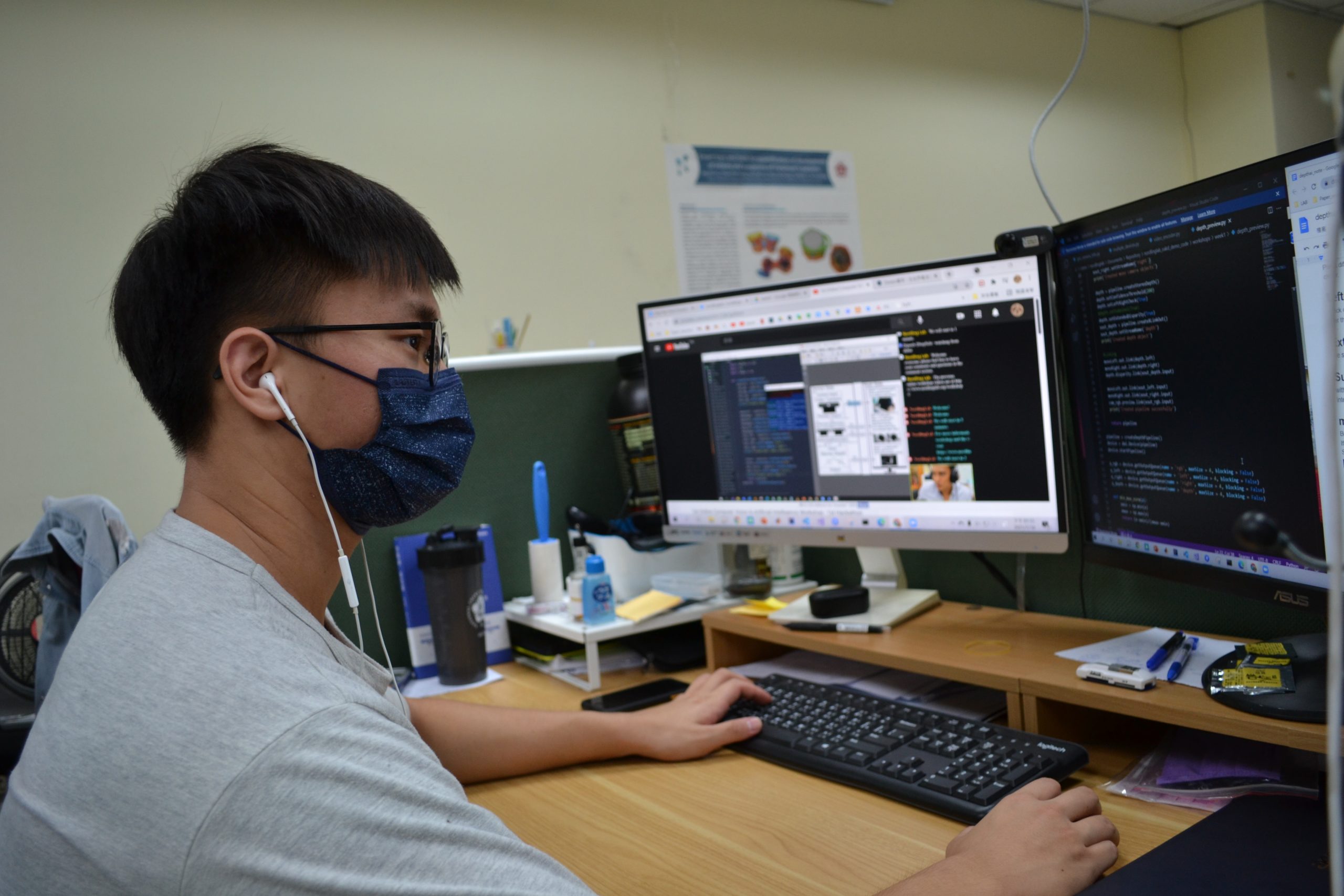
Hands on – Gallery

The National Cheng Kung University‘s Parkinson’s Disease Quantifiers team

Our Sponsors




Time Zone
All times are listed in UTC+8, i.e. China Standard Time (CST) or Taipei Time, which is 8 hours ahead of Coordinated Universal Time (UTC).
About NCKU
The National Cheng Kung University (NCKU) is one of the two major comprehensive universities in Taiwan with app. 22 000 full-time students, attracting some of the best students in Taiwan. NCKU is number one in Academia-Industry Collaborations nationwide. Times Higher Education placed NCKU 38th in Impact Rankings 2020, 103rd in Asia University Rankings 2020. Academic Ranking of World Universities placed NCKU 301-400th internationally.
About AIA
Taiwan Artificial Intelligence Association (AIA) was founded in 2020, a leading purpose-driven organization for promoting commercialization of AI application, as well as advanced AI digital transformation for national and global industries.
About OpenCV
OpenCV (Open Source Computer Vision Library) is an open source computer vision and machine learning software library. OpenCV was built to provide a common infrastructure for computer vision applications and to accelerate the use of machine perception in the commercial products. Being a BSD-licensed product, OpenCV makes it easy for businesses to utilize and modify the code.
The library has more than 2500 optimized algorithms, which includes a comprehensive set of both classic and state-of-the-art computer vision and machine learning algorithms. These algorithms can be used to detect and recognize faces, identify objects, classify human actions in videos, track camera movements, track moving objects, extract 3D models of objects, produce 3D point clouds from stereo cameras, stitch images together to produce a high resolution image of an entire scene, find similar images from an image database, remove red eyes from images taken using flash, follow eye movements, recognize scenery and establish markers to overlay it with augmented reality, etc. OpenCV has more than 47 thousand people of user community and estimated number of downloads exceeding 18 million. The library is used extensively in companies, research groups and by governmental bodies.
Along with well-established companies like Google, Yahoo, Microsoft, Intel, IBM, Sony, Honda, Toyota that employ the library, there are many startups such as Applied Minds, VideoSurf, and Zeitera, that make extensive use of OpenCV. OpenCV’s deployed uses span the range from stitching streetview images together, detecting intrusions in surveillance video in Israel, monitoring mine equipment in China, helping robots navigate and pick up objects at Willow Garage, detection of swimming pool drowning accidents in Europe, running interactive art in Spain and New York, checking runways for debris in Turkey, inspecting labels on products in factories around the world on to rapid face detection in Japan.
It has C++, Python, Java and MATLAB interfaces and supports Windows, Linux, Android and Mac OS. OpenCV leans mostly towards real-time vision applications and takes advantage of MMX and SSE instructions when available. A full-featured CUDAand OpenCL interfaces are being actively developed right now. There are over 500 algorithms and about 10 times as many functions that compose or support those algorithms. OpenCV is written natively in C++ and has a templated interface that works seamlessly with STL containers.
About Luxonis
Our mission is to improve the engineering efficiency of embedding performant, spatial AI + CV into products. We do this by building and maintaining the open-source DepthAI ecosystem (more) which is also now the OpenCV AI Kit.
In other words, we build the core technology that allows human-like perception in real products – allowing 0-to-1 applications in nearly every industry. The technology allows solving problems that need human-like perception, but say in a 1″ cube. A good external writeup about Luxonis is on Bloomberg.
We are enabling what was science-fiction as of 2017:
- Wearable devices that perceive the world and allow the blind to perceive through soundscapes
- Embedded systems that can automatically protect endangered species
- Robots that enable organic farming with zero chemicals (by using lasers to target weeds and pests)
- Perception built into heavy machinery to real-time protect the health and safety of workers.
- Perception built into remote areas to autonomously monitor and protect the environment from leaks and other hazardous conditions.
- New forms of communication devices – bridging the gap between the in-person experience and the Zoom experience.
The above are just quick examples. There are countless solutions to fascinating problems being built off of our platform, with 15,000 devices shipped to date, in the hands of thousands of companies, some of which are working to integrate our technology into their own products.
We are a small startup with aims to have an outsized impact on the world. Still in the earliest stages, the solutions built with our technology have been covered in every top news, tech, and science publication in the world (Forbes, WSJ, Bloomberg, Washington Post, Engadget, etc.). We hold the records (independently) for the largest KickStarter raise for a computer vision project, for an AI project, and for a printed circuit board project.
Our mission is to materially improve the engineering efficiency of the world. This is what our team (and backers) previously did in another market (in business WiFi, with UniFi). And we now aim to do the same for this super-power of human-like perception in embedded systems – making it so prototyping with this power takes hours, and implementing it into a product is as fast as an enclosure can be designed and produced.
We are currently hiring:
Register Now!
We sincerely invite anyone in the world interested in spatial AI to participate. The workshop is held online and is free for everyone.
Organizer: The Nordling Lab @ National Cheng Kung University in Taiwan
Co-organizer: Taiwan Artificial Intelligence Association (AIA)
Honorary Chair: Chair Prof. Cheng-Wen Wu
General Chair: Ass. Prof. Torbjörn Nordling
Technical Chair: Asc. Prof. Chi-Lun Lin
Assisting Chair: Dr. Akram Ashyani
Speaker Coordinators: Esteban Roman, Ray Chen
Lead Hacker: Jose Ramon Chang
Assisting Hackers: Jacob Chen, Ric Tu
Chat Host: Rain Wu
Streamer: Austin Su
Camera Operators: Ric Tu, YuShan Lin
Photographer: Gavin Vivaldy
Designer: Victor Osorio
Administrators: Winnie Tu, Anna Chu